Fed holds rates steady as dollar rises to 98.88
April 30, 2026
What This Means
Treasury yields will rise further: The Federal Open Market Committee held rates steady for a third consecutive meeting while Goldman Sachs analysts upgraded their 2026 core PCE inflation forecast to 2.6%, signaling that persistent price pressures will keep borrowing costs elevated.
The U.S. Dollar Index will strengthen: The U.S. Dollar Index climbed 0.2% to 98.88 as the market digested the central bank's hawkish stance, with the currency poised to gain more ground against peers like the British Pound which rose 0.4% to $1.3473 following its own separate rate decision.
This reflects observable market data. Individual situations vary — always verify with your own research.
Today's Summary
- Fed keeps rates unchanged while dollar rises and inflation forecasts climb.
Top Signals
- Federal Open Market Committee: Fed member votes for rate cut amid economic uncertainty (25 basis points) ↗ source
- U.S. Dollar Index: Dollar strengthens following Fed decision and inflation data (up 0.2% to 98.88) ↗ source
- Goldman Sachs: Investment bank raises inflation forecast for 2026 (2.6%, 2.5%) ↗ source
- British Pound: Sterling gains ground against dollar after UK rate decision (up 0.4%, $1.3473) ↗ source
Read analysis
The Federal Open Market Committee chose to hold the federal funds rate steady for a third consecutive meeting, reflecting a cautious stance amid lingering economic uncertainty. This decision stood in contrast to the dissenting view of Stephen Miran, who argued for an immediate quarter-point cut to address cooling demand. Market reactions were mixed, as the U.S. Dollar Index edged higher while the British Pound gained ground following separate policy signals from the Bank of England. Compounding the uncertainty, Goldman Sachs analysts recently revised their inflation outlook upward, suggesting that price pressures may remain stickier than previously anticipated through 2026.
Why it happened
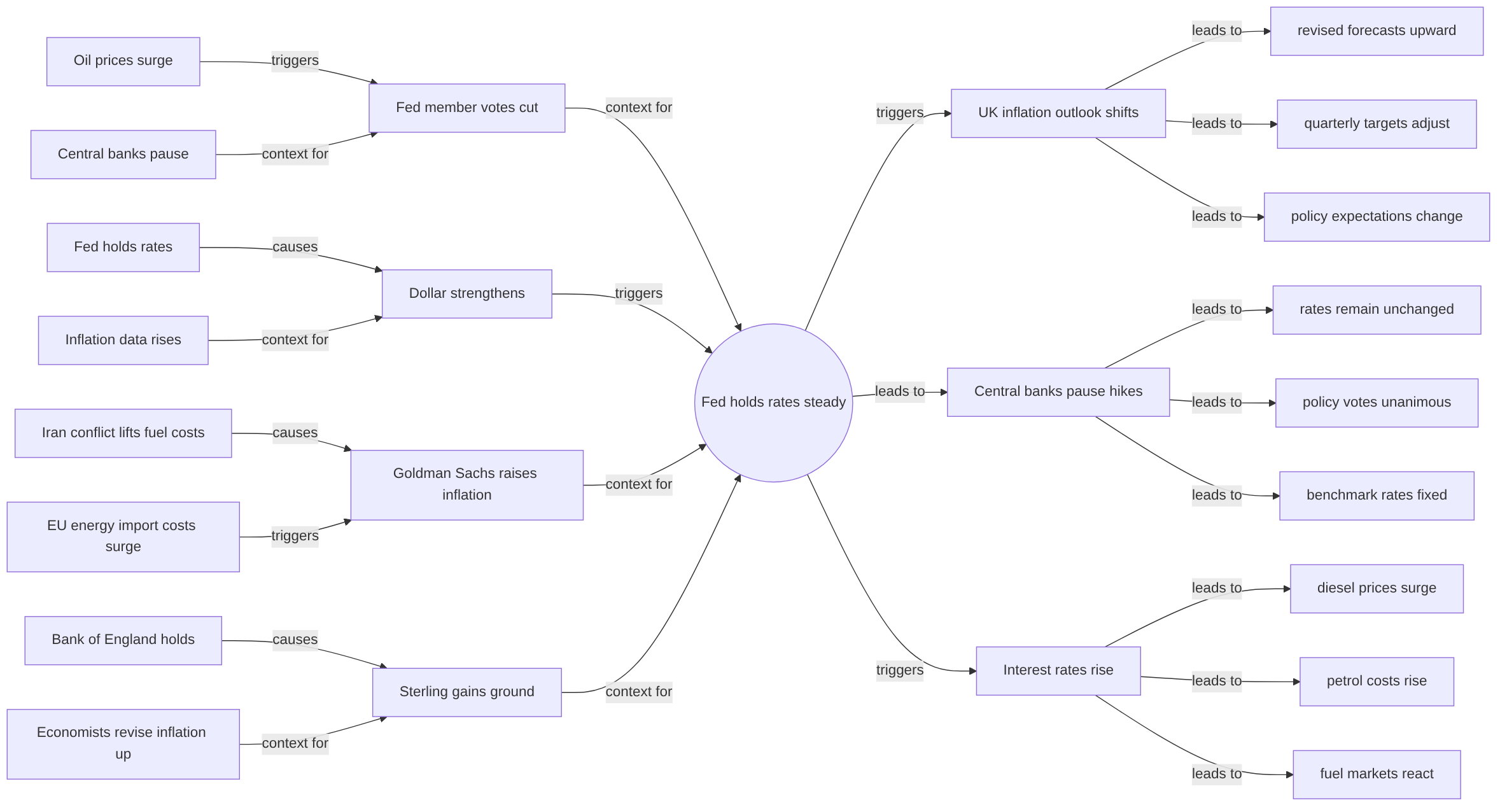
Fed member votes cut: A Federal Open Market Committee member advocated for a rate reduction despite prevailing economic uncertainty. ↗ source
Dollar strengthens: The U.S. Dollar Index gained value as investors reacted to the Federal Open Market Committee decision and fresh inflation data. ↗ source
Goldman Sachs raises inflation: Goldman Sachs raised its inflation forecast for 2026, adding pressure on the Federal Open Market Committee to maintain current rates. ↗ source
↳ Iran conflict lifts fuel costs: Rising petrol and diesel prices driven by the Iran conflict pushed energy costs higher, fueling inflation concerns. ↗ source
↳ EU energy import costs surge: A sharp increase in EU fossil fuel import costs during the conflict highlighted global inflationary risks. ↗ source
Sterling gains ground: The British Pound strengthened against the U.S. Dollar Index following the UK rate decision, influencing global currency dynamics. ↗ source
Read analysis
Rising fuel costs driven by geopolitical tensions in the Middle East, alongside a revised upward forecast for UK inflation, have placed renewed pressure on central banks to maintain their current interest rate policies. These immediate market shifts stem from the Federal Open Market Committee keeping rates steady while the British Pound faces volatility, all set against a backdrop of EU nations grappling with soaring fossil fuel import expenses and warnings of potential strikes on British bases. This pattern underscores how global energy security concerns and inflation expectations continue to dictate monetary decisions across major economies.
What comes next
UK inflation outlook shifts: Economists now project UK inflation near 3% by mid-2026 following recent policy decisions.
↳ revised forecasts upward
↳ quarterly targets adjust
↳ policy expectations change
Central banks pause hikes: Major global central banks including the Bank of England and Canada hold rates steady.
↳ rates remain unchanged
↳ policy votes unanimous
↳ benchmark rates fixed
Interest rates rise: Rising geopolitical tensions push petrol and diesel prices to record highs this week.
↳ diesel prices surge
↳ petrol costs rise
↳ fuel markets react
Read analysis
With the Federal Open Market Committee holding rates steady for a third consecutive meeting, markets will now scrutinize the dissenting vote from Stephen Miran as a potential signal of shifting internal sentiment. Investors should watch the U.S. Dollar Index for volatility following its modest rise, while the British Pound gains momentum after the Bank of England's unanimous decision to keep rates unchanged. Meanwhile, Goldman Sachs has adjusted its inflation outlook higher for 2026, suggesting that future policy moves may need to be more aggressive than currently priced in. The coming weeks will likely hinge on whether central banks maintain their current stance or pivot in response to these evolving price pressures.