Hormuz Closure Sends Oil to $100 Amid Supply Fears
April 26, 2026
What This Means
Crude oil prices will climb further: The closure of the Strait of Hormuz, which disrupts 10% of global oil supply, combined with Donald Trump's warning that U.S. military forces could eliminate Iran's weaponry in a single day, creates a supply shock that is likely to push benchmark crude well beyond the current $96.66 per barrel level.
Energy sector stocks are poised to outperform: As U.S. Consumer Inflation reached 3.3 percent and the UK Consumer Price Index rose to 3.3%, the geopolitical tension in the Middle East suggests that energy companies will see their margins expand significantly as commodity prices rise to meet the constrained supply.
This reflects observable market data. Individual situations vary — always verify with your own research.
Today's Summary
- Strait of Hormuz closure and Iran threats push crude prices near $100.
Top Signals
- Strait of Hormuz: Closure disrupts global oil supply by 10 percent (10%) ↗ source
- Donald Trump: Threatens elimination of Iranian weaponry amid tensions ↗ source
- U.S. Consumer Inflation: Rises to 3.3 percent in March (3.3%) ↗ source
- UK Consumer Price Index: Rises to 3.3 percent in March from 3% in February (3.3%) ↗ source
Read analysis
Oil prices surged as the closure of the Strait of Hormuz cut off a critical 10% of global supply, creating immediate scarcity concerns. This disruption was compounded by heightened tensions after Donald Trump warned that U.S. forces could dismantle Iran's weaponry within a single day, fueling fears of further regional instability. Meanwhile, the market remains sensitive to persistent price pressures, with U.S. Consumer Inflation holding at 3.3% and the UK Consumer Price Index rising to the same level, suggesting that any supply shock will have lasting effects on the broader economy.
Why it happened
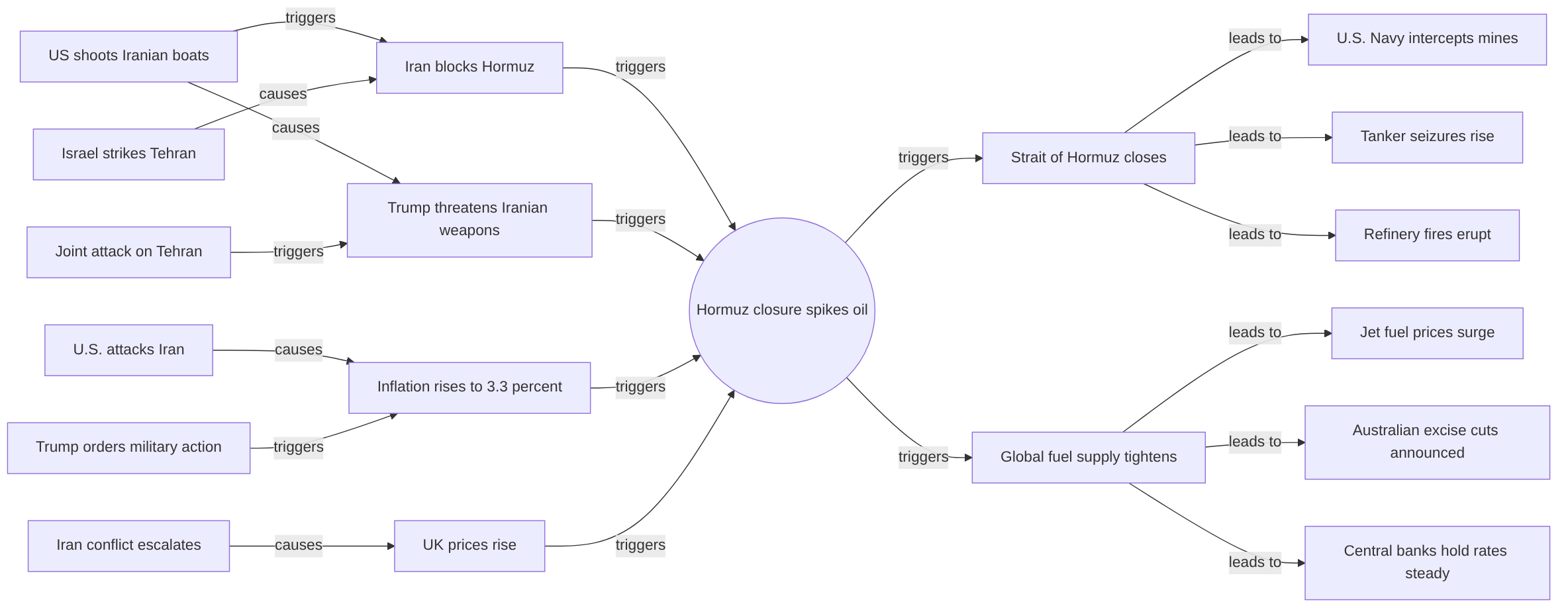
Iran blocks Hormuz: A blockade in the Strait of Hormuz cuts global supply by 10 percent. ↗ source
Trump threatens Iranian weapons: Threats to eliminate Iranian weaponry heighten tensions, spiking fears of a Strait of Hormuz closure. ↗ source
Inflation rises to 3.3 percent: Rising U.S. Consumer Inflation to 3.3 percent reflects broader price pressures driven by energy costs. ↗ source
Read analysis
Escalating tensions in the Strait of Hormuz, including a joint U.S. and Israeli strike on Tehran and a deadly fire at a Victorian fuel plant, have directly triggered a sharp surge in global energy prices. These immediate disruptions were fueled by a backdrop of heightened regional hostilities, where Iran's robust export volumes and intercepted ballistic missiles signaled a volatile supply environment that threatened to choke off critical fuel flows. As the conflict persists, the resulting price spikes are exerting significant upward pressure on U.S. Consumer Inflation and the UK Consumer Price Index, while Donald Trump has authorized aggressive military measures to secure maritime routes against Iranian mining operations.
What comes next
Strait of Hormuz closes: Geopolitical tension in the Persian Gulf halts major shipping lanes and spikes global oil prices.
↳ U.S. Navy intercepts mines
↳ Tanker seizures rise
↳ Refinery fires erupt
Global fuel supply tightens: Conflicts between Israel, Iran, and the U.S. disrupt energy flows worldwide.
↳ Jet fuel prices surge
↳ Australian excise cuts announced
↳ Central banks hold rates steady
Read analysis
With the Strait of Hormuz effectively closed and Donald Trump threatening a swift military strike against Iran, the market faces a severe supply shock that could push benchmark crude prices well beyond the $100 mark. Investors must now monitor whether diplomatic de-escalation occurs or if retaliatory attacks on British bases and industrial sites in the UAE escalate the conflict further. This geopolitical volatility arrives alongside rising U.S. Consumer Inflation and a UK Consumer Price Index reading of 3.3 percent, creating a precarious environment where energy costs and persistent price pressures could force central banks to maintain restrictive monetary policies. As gasoline prices remain sensitive to these disruptions, the interplay between supply constraints and inflation data will likely dictate the trajectory for global equities and energy sectors in the coming weeks.