Fed holds rates as yen weakens to 159.12
April 28, 2026
What This Means
Treasury yields will climb further: The Federal Reserve is expected to leave rates unchanged, signaling that monetary policy will remain restrictive for longer than markets anticipated.
The Yen is set to weaken against the dollar: The Bank of Japan raised its core inflation forecast to 2.8% for 2026 while the currency already traded at 159.12, suggesting a widening gap in economic momentum that favors the dollar.
This reflects observable market data. Individual situations vary — always verify with your own research.
Today's Summary
- Fed keeps rates unchanged while global inflation data shifts outlook.
Top Signals
- Federal Reserve: Fed expected to leave interest rates unchanged ↗ source
- Bank of Japan: Bank of Japan raises core inflation forecast to 2.8 percent (2.8%) ↗ source
- Iran: Iran war mentioned in context of German inflation and GDP forecasts ↗ source
- Yen: Yen weakens over 1.5 percent against the dollar (1.5%) ↗ source
Read analysis
Market attention remains fixed on the Federal Reserve as policymakers prepare to hold interest rates steady, reflecting a cautious approach to cooling inflation. Simultaneously, the Bank of Japan has signaled a shift in its outlook by raising its core inflation forecast for 2026, a move that has contributed to the Yen weakening significantly against the United States dollar. This currency pressure is further compounded by slowing growth expectations in the euro area, where revised GDP figures suggest a more challenging economic landscape ahead. While geopolitical tensions involving Iran continue to loom in the background, the immediate market drivers are the diverging monetary signals from Tokyo and Washington.
Why it happened
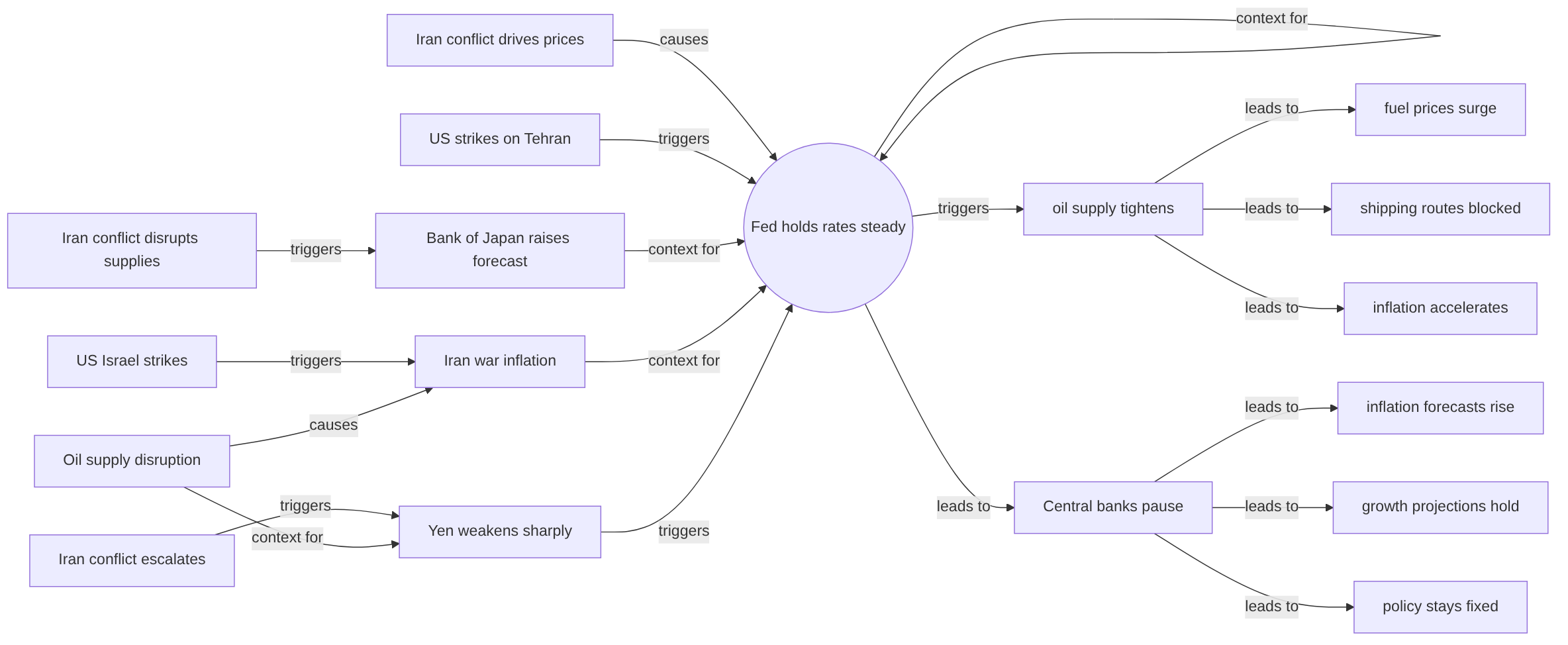
Fed holds rates steady: The Federal Reserve paused rate hikes as Iran conflict drove energy prices higher. ↗ source
Bank of Japan raises forecast: The Bank of Japan's higher inflation outlook reinforces the Federal Reserve's decision to hold rates steady. ↗ source
↳ Iran conflict disrupts supplies: Ongoing conflict in Iran has caused major disruptions to global oil and gas supplies. ↗ source
Iran war inflation: Geopolitical conflict involving Iran drove inflation fears, influencing Federal Reserve rate decisions. ↗ source
Yen weakens sharply: A weaker Yen reflects market volatility driven by the Federal Reserve holding rates steady. ↗ source
Read analysis
Escalating tensions between Iran and its neighbors, including a joint U.S.-Israeli attack on Tehran and the disruption of global oil supplies, have forced central banks like the Federal Reserve to maintain high benchmark rates to combat inflation. These immediate shocks were fueled by a volatile backdrop of missile exchanges across the Middle East and a fragile, brokered cease-fire that failed to stabilize the region. This pattern underscores how geopolitical instability in key energy corridors can rapidly dictate monetary policy decisions worldwide, affecting currencies like the Yen and the strategies of institutions such as the Bank of Japan.
What comes next
oil supply tightens: Global energy markets face historic disruption from the U.S.-Israel conflict with Iran.
↳ fuel prices surge
↳ shipping routes blocked
↳ inflation accelerates
Central banks pause: RBI and other institutions hold rates steady amid rising geopolitical inflation risks.
↳ inflation forecasts rise
↳ growth projections hold
↳ policy stays fixed
Read analysis
With the Federal Reserve expected to hold rates steady, investors will closely monitor how the Bank of Japan's revised inflation outlook influences the weakening Yen and global capital flows. The sharp rise in German inflation alongside a downward revision to euro area growth forecasts suggests the Federal Reserve may face a more complex path forward as European economic momentum slows. Meanwhile, escalating tensions involving Iran and its neighbors continue to cast a shadow over energy markets, potentially complicating the outlook for crude prices even as central banks prioritize domestic stability. Traders should watch whether the Yen's continued slide against the dollar accelerates amid these diverging regional risks and policy signals.