Japan holds rates at 0.75% as yen weakens 1.5%
April 29, 2026
What This Means
Treasury yields will climb further: Australia's inflation rate surged to 4.6% in March, the highest since monthly data began in 2025, signaling that the Federal Reserve may delay rate cuts to combat persistent price pressures.
Energy stocks are set to outperform: OPEC production plummeted 27% to 20.79 million barrels per day amid the Iran War, creating a supply deficit that will likely drive crude prices higher.
This reflects observable market data. Individual situations vary — always verify with your own research.
Today's Summary
- Interest Rates
Top Signals
- Federal Reserve: Federal Reserve expected to leave interest rates unchanged ↗ source
- Iran War: Iran War impacts OPEC production and global markets ↗ source
- OPEC: OPEC production fell 27 percent to 20.79 million barrels per day (27%) ↗ source
- Australia: Australia inflation rose to 4.6 percent in March (4.6%) ↗ source
Read analysis
Inflation in Australia climbed to its highest level since 2025 as supply constraints tightened, prompting the Federal Reserve to hold rates steady while global markets grappled with fresh volatility. The Iran War has severely disrupted energy flows through the Strait of Hormuz, driving OPEC production down by over a quarter and fueling broader price pressures. Meanwhile, the Bank of Japan kept its benchmark unchanged despite the yen weakening significantly against the dollar, reflecting a complex interplay between domestic stability and external commodity shocks.
Why it happened
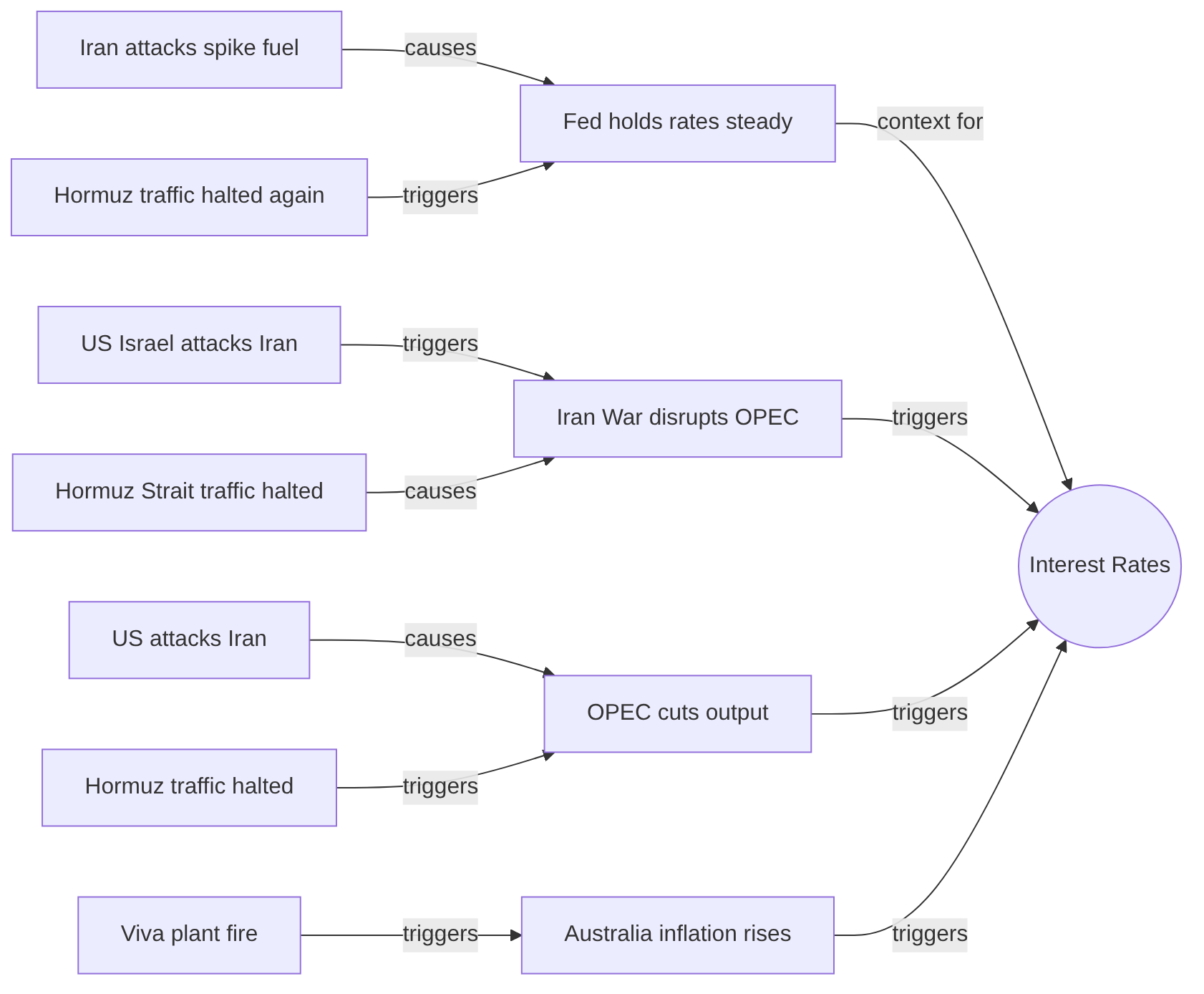
Fed holds rates steady: The Federal Reserve kept rates unchanged as Iran War tensions drove energy costs higher. ↗ source
Iran War disrupts OPEC: The Iran War threatens OPEC output, forcing the Federal Reserve to reconsider rate cuts amid rising inflation. ↗ source
OPEC cuts output: OPEC production drops 27 percent, tightening supply and pushing rates higher. ↗ source
Read analysis
Escalating tensions in the Iran War, marked by a joint U.S.-Israel attack on Tehran and subsequent disruptions to the Strait of Hormuz, have directly fueled volatility in global markets. These immediate flashpoints are rooted in a broader backdrop of soaring energy prices and inflationary pressures that have prompted the Federal Reserve to maintain its benchmark rate at a restrictive 3.5% to 3.75%. This pattern underscores how geopolitical instability in key oil-producing regions continues to drive monetary policy decisions across major economies, including Australia and nations within OPEC.
What comes next
Based on the collected data, Interest Rates is the most downstream effect — no further causal chain was found in the knowledge graph.
Read analysis
With Australia reporting its highest inflation rate since 2025, the Federal Reserve is likely to maintain its current stance while markets brace for further volatility driven by the escalating Iran War. The conflict has already triggered a 27% drop in OPEC output, pushing West Texas Intermediate oil prices above $112 a barrel and threatening to reignite global price pressures. Investors will closely monitor whether the Federal Reserve signals a shift in policy as the yen weakens and energy supply chains face renewed disruption from the Strait of Hormuz. Any further escalation in the region could force central banks to reconsider their timelines for rate adjustments amid these compounding supply shocks.