Oil surges past $100 amid US blockade threats
April 14, 2026
What This Means
Oil prices will climb further: West Texas Intermediate has already surged 8.61% to $104.88 as US Central Command initiates a maritime blockade, but analysts warn that prices could reach $150 if the US proceeds with a full blockade of the Strait of Hormuz.
Energy sector volatility will intensify: Iran has issued a stern warning that any military vessels entering the Strait of Hormuz will be treated as a ceasefire violation, creating a high-risk environment that will likely drive energy stocks higher while increasing market uncertainty.
This reflects observable market data. Individual situations vary — always verify with your own research.
Today's Summary
- Oil / Energy Prices
Top Signals
- Iran: Iranian Revolutionary Guards threaten blockade of Strait of Hormuz ↗ source
- US Central Command: US Central Command initiates blockade of maritime traffic in region ↗ source
- West Texas Intermediate: West Texas Intermediate prices surge to $104.88 amid blockade threats ↗ source
Read analysis
Oil prices surged past $100 a barrel, with West Texas Intermediate climbing 8.61% to $104.88, driven by escalating tensions between the US Central Command and Iran. The market reacted sharply after Iran warned that any military vessels approaching the Strait of Hormuz would face severe consequences, while reports emerged of a planned blockade on Iranian ports. These conflicting signals have sparked fears that a full closure of the critical waterway could push crude prices toward $150 per barrel.
Why it happened
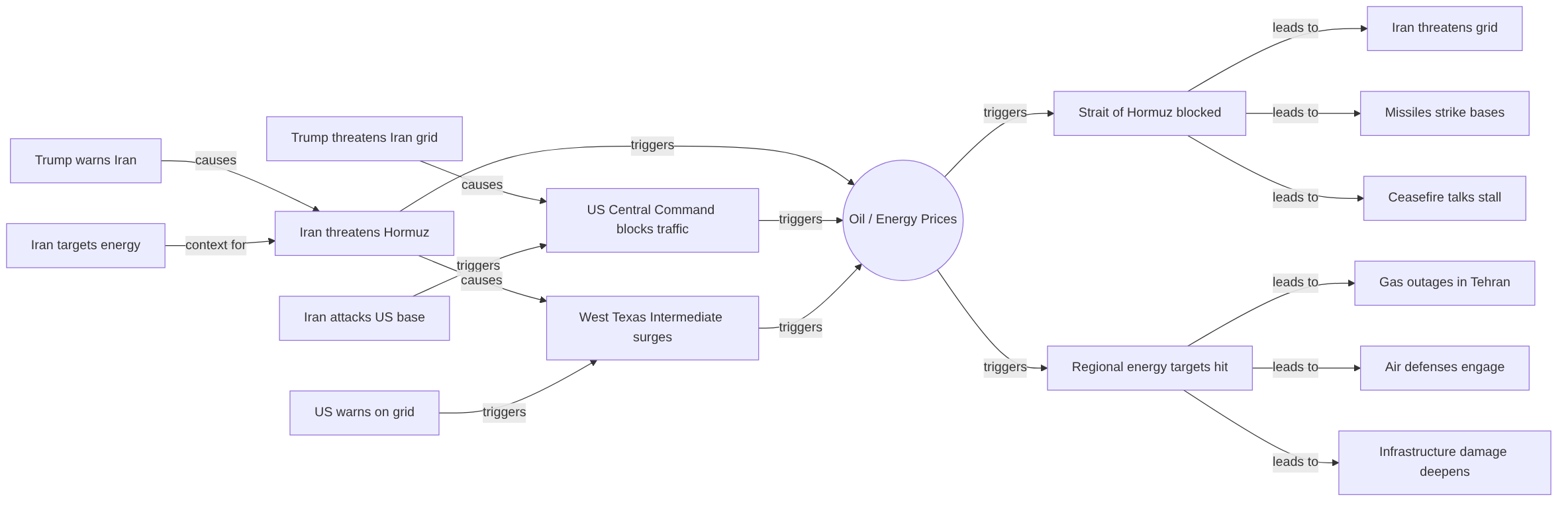
Iran threatens Hormuz: Threats to blockade the Strait of Hormuz by Iran send global oil markets into immediate volatility. ↗ source
US Central Command blocks traffic: US Central Command blockade of maritime traffic disrupts global oil supply chains. ↗ source
West Texas Intermediate surges: West Texas Intermediate prices jumped to $104.88 as threats to block shipping routes sparked immediate market panic. ↗ source
↳ Iran threatens Hormuz: Iran warned it could block the Strait of Hormuz, directly threatening global oil transit and spiking West Texas Intermediate values. ↗ source
↳ US warns on grid: President Trump vowed to bombard Iran's power grid if shipping lanes remained closed, escalating fears for US Central Command and energy markets. ↗ source
Read analysis
Tensions in the Middle East have surged after Iran threatened to close the Strait of Hormuz, prompting President Trump to warn of potential strikes on the nation's power grid if shipping lanes remain blocked. This immediate geopolitical friction is set against a backdrop of rising fuel costs and ongoing regional instability that began with the Israel-Iran conflict in late February. The situation underscores how quickly military posturing by US Central Command and regional actors can translate into volatile energy markets, directly impacting prices for West Texas Intermediate and consumer gasoline.
What comes next
Strait of Hormuz blocked: Threats to close the vital shipping lane spark immediate global supply fears.
↳ Iran threatens grid
↳ Missiles strike bases
↳ Ceasefire talks stall
Regional energy targets hit: Direct attacks on power and desalination facilities threaten regional stability.
↳ Gas outages in Tehran
↳ Air defenses engage
↳ Infrastructure damage deepens
Read analysis
With Iran threatening to treat any military vessels near the Strait of Hormuz as a violation of the ceasefire, the market is bracing for a potential supply shock that could push West Texas Intermediate toward $150 per barrel. The situation escalated further as US Central Command initiated a blockade of maritime traffic entering and exiting Iranian ports, driving crude prices above $100 and stoking fears of a prolonged disruption. Investors will closely monitor whether the blockade expands to the critical shipping lane, as such a move would likely force global energy costs higher and strain economies dependent on the region's oil flows. The coming days will determine if these geopolitical tensions translate into a sustained price rally or if diplomatic channels can de-escalate the standoff before the supply chain fractures further.