U.S. Gas Prices Hit 21.2% Surge in March
Today's Summary
Iran Strait blockade and inflation surge drive energy prices to historic highs.
Top Signals
- Donald Trump: Threatens Iran over Hormuz fees, escalating geopolitical tensions ↗ source
- Strait of Hormuz: Shipping traffic drops 95% amid security concerns and threats (95%) ↗ source
- Gasoline: Prices rose 21.2% in March, the largest one-month increase since 1967 (21.2%) ↗ source
- U.S. Inflation: Annual rate hits 3.3% driven by energy and war costs (3.3%) ↗ source
Read analysis
Tensions in the Middle East surged after Donald Trump threatened Iran with military force over tolls on tankers navigating the Strait of Hormuz, causing a near-total halt in maritime traffic that typically moves hundreds of vessels daily. This geopolitical friction directly fueled a sharp spike in Gasoline prices, which jumped over 21% in March to reach levels not seen since 1967. Consequently, the broader U.S. Inflation rate climbed to 3.3% as energy costs permeated the economy, even as markets briefly rallied on hopes of a ceasefire.
Why it happened
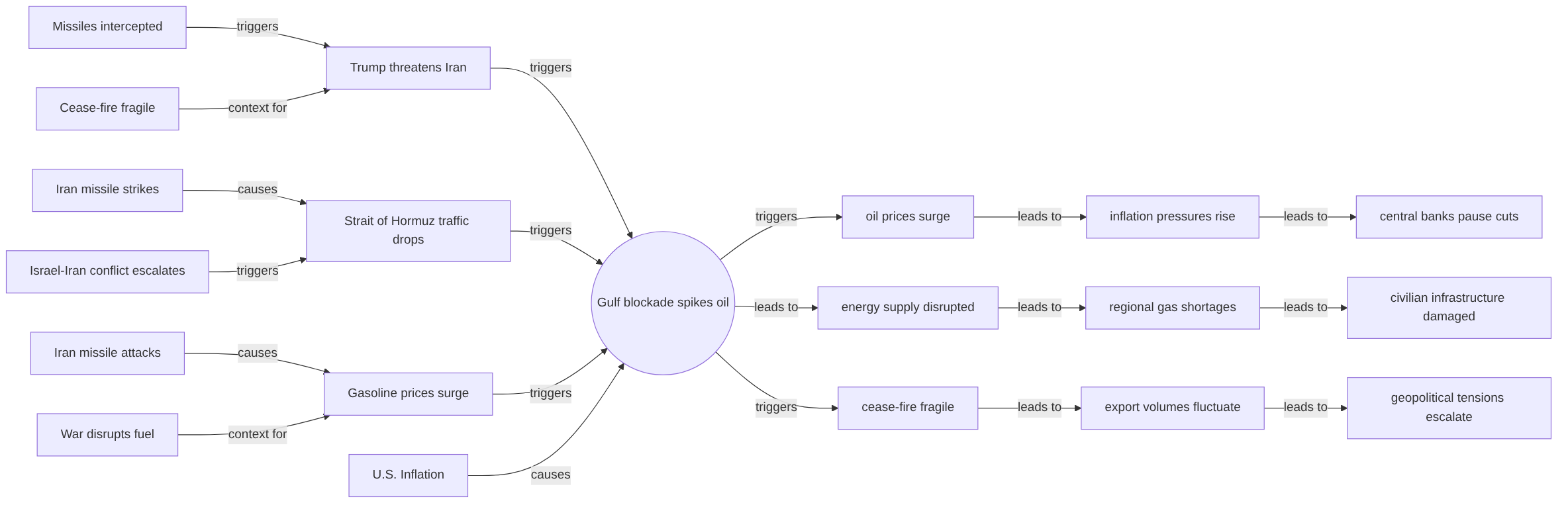
Trump threatens Iran: Donald Trump's threats over the Strait of Hormuz fuel fears of a supply cutoff, spiking oil prices. ↗ source
↳ Missiles intercepted: Saudi Arabia and the UAE intercepted ballistic missiles, escalating regional tensions that prompted Donald Trump to issue threats. ↗ source
↳ Cease-fire fragile: A fragile truce and Donald Trump's impatience to end the war created the volatile backdrop for his latest statements. ↗ source
Strait of Hormuz traffic drops: Security threats in the Strait of Hormuz slash shipping traffic, spiking global oil prices. ↗ source
Gasoline prices surge: Soaring Gasoline costs reflect the market's reaction to regional instability and supply fears. ↗ source
U.S. Inflation ↗ source
Read analysis
Escalating military tensions, including missile strikes across the Middle East and Donald Trump's announcement of a rapid U.S. withdrawal from Iran, have directly threatened energy infrastructure and shipping lanes. These immediate disruptions are unfolding against a backdrop of already elevated Gasoline prices and broader economic pressures, with U.S. Inflation concerns rising alongside global growth projections. This pattern underscores how geopolitical flashpoints can rapidly transmit volatility to consumer fuel costs and macroeconomic stability.
What comes next
oil prices surge: Conflict in the Gulf pushes West Texas Intermediate above $112 a barrel.
↳ inflation pressures rise
↳ ↳ central banks pause cuts
energy supply disrupted: Iranian missile strikes and air defense operations halt fuel flows to Tehran.
↳ regional gas shortages
↳ ↳ civilian infrastructure damaged
cease-fire fragile: A two-week truce brokered by Pakistan fails to stabilize the Strait of Hormuz.
↳ export volumes fluctuate
↳ ↳ geopolitical tensions escalate
Read analysis
The severe disruption at the Strait of Hormuz, where tanker traffic has plummeted to just seven vessels daily, sets the stage for a prolonged supply crunch that could push Gasoline prices to unprecedented levels. As Donald Trump escalates rhetoric against Iran, any further attacks on energy infrastructure or shipping lanes will likely reignite fears of a global shortage, keeping crude benchmarks like WTI under intense upward pressure. This geopolitical volatility is already feeding into a sticky U.S. Inflation environment, with recent data showing price surges that complicate the Federal Reserve's path forward. While the S&P 500 recently rebounded on ceasefire hopes, the market will remain fragile as long as the flow of oil through the strait remains critically constrained. Investors should watch for any sudden shifts in transit numbers, as even a brief return to normalcy could stabilize prices, but a continued blockade threatens to deepen the inflationary spiral.
What This Means
Crude oil prices will climb further: With only seven ships passing through the Strait of Hormuz compared to the normal 140, the physical supply shock from Donald Trump's threats of a missile barrage against Iran is already severe and likely to drive WTI benchmarks higher as markets price in the risk of a total blockade.
Energy stocks are set to outperform the broader market: As Gasoline prices surged 21.2% in March and U.S. Inflation hit 3.3%, the sector is poised to rally on the back of higher commodity valuations, even as the S&P 500 recently rebounded on ceasefire hopes that may prove fragile against the reality of restricted shipping lanes.
This reflects observable market data. Individual situations vary — always verify with your own research.